One of the biggest misconceptions in post-production is that preparing a project for the sound team is simply a matter of exporting an AAF.
In reality, a good sound conform starts long before that export button is ever pressed.
Like every other stage of post-production, the quality of the handover directly affects the quality of the work that follows. A well-prepared project allows the Sound Designer to focus on storytelling, emotion and rhythm, rather than spending valuable time fixing organisation, searching for missing clips or rebuilding a confusing timeline.
Like every other stage of post-production, the quality of the handover directly affects the quality of the work that follows. A well-prepared project allows the Sound Designer to focus on storytelling, emotion and rhythm, rather than spending valuable time fixing organisation, searching for missing clips or rebuilding a confusing timeline.
The goal isn't simply to send files. The goal is to make the transition between editorial and sound as seamless as possible.
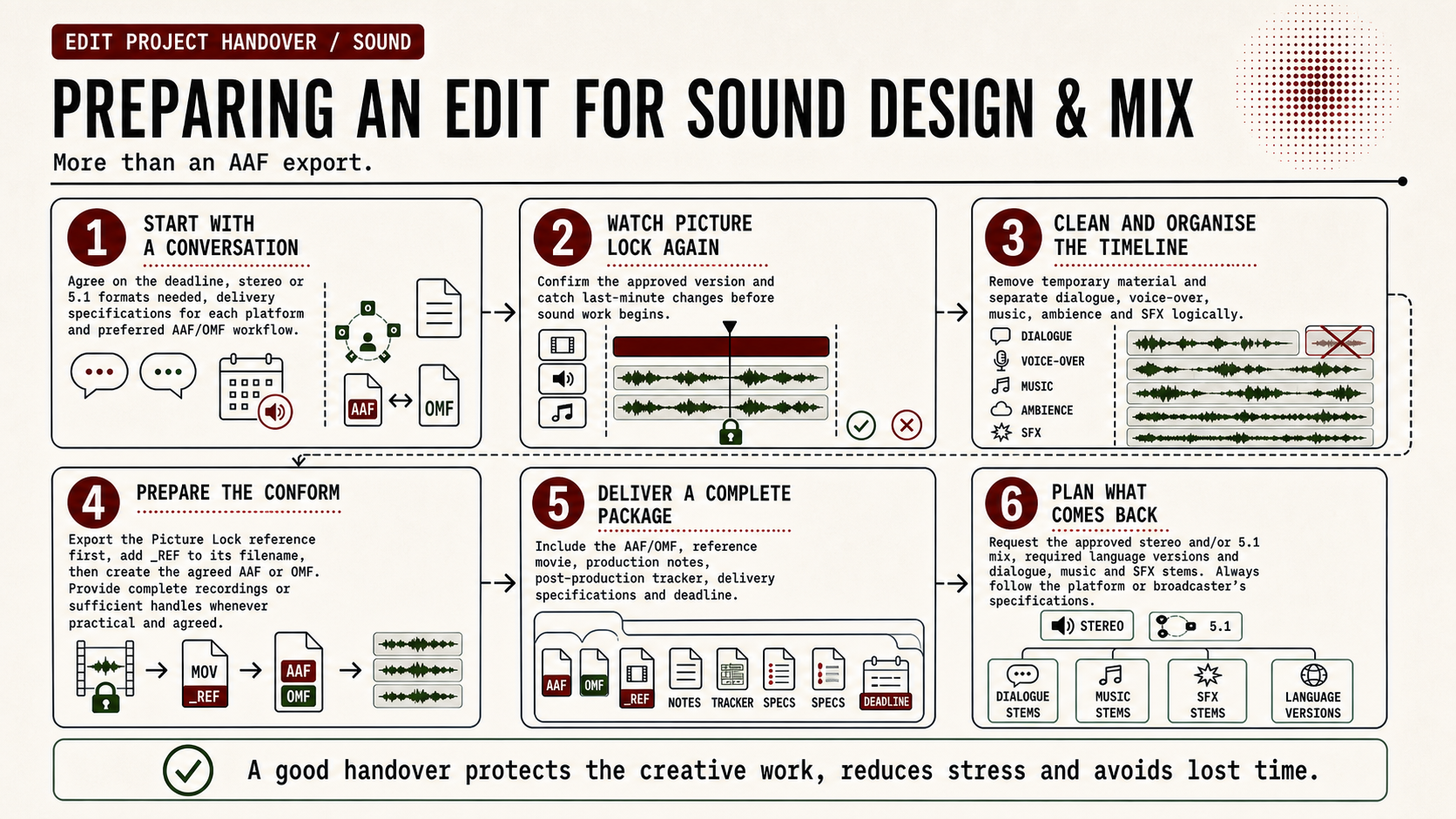
It all starts with a conversation
Before I touch the project, I like to have a short call with the Sound Designer, together with the Post Producer whenever possible. Every production is different, and this is the perfect opportunity to align expectations before work begins.
We'll discuss the type of delivery required, whether the project is intended for online platforms, broadcast or cinema, the expected audio formats, whether the mix will be stereo, 5.1, Atmos or another format, delivery deadlines and, of course, the preferred workflow.
Some sound teams prefer working with AAFs, others may still request OMFs, while larger productions often have their own established pipeline.
Five or ten minutes of conversation at the beginning can save hours of unnecessary revisions later.
Five or ten minutes of conversation at the beginning can save hours of unnecessary revisions later.
Watch the Picture Lock one more time
Once everything is aligned, I watch the approved Picture Lock from beginning to end.
This final viewing is an opportunity to confirm that the correct version has been approved, check for any last-minute changes and mentally walk through everything the Sound Designer will receive.
If something feels wrong now, it's much easier to solve before the conform begins than after the sound mix is already in progress.
If something feels wrong now, it's much easier to solve before the conform begins than after the sound mix is already in progress.
Clean and organise the timeline
With the Picture Lock confirmed, the next step is preparing the timeline.
Temporary material, accidental duplicates and genuinely unnecessary tracks should be removed, but I'm careful not to throw away useful production sound.
Temporary material, accidental duplicates and genuinely unnecessary tracks should be removed, but I'm careful not to throw away useful production sound.
Alternate microphones, ISO tracks, longer takes or original production audio may become extremely useful to the dialogue editor later, even if they weren't audible in the approved edit.
I also make sure the audio is organised logically: Dialogue, voice-over, music, sound effects and ambience each have their own dedicated tracks whenever possible.
The objective isn't to create a perfect-looking timeline, but to create one that immediately makes sense to the person opening it.
The cleaner the sequence, the easier it becomes for the Sound Designer to concentrate on creating a great mix rather than decoding the editor's project.
The cleaner the sequence, the easier it becomes for the Sound Designer to concentrate on creating a great mix rather than decoding the editor's project.
Preparing the conform
Only after the project is organised do I start preparing the conform itself.
The first file I always export is a reference video of every Picture Lock edit. I usually add _REF to the filename so it's immediately clear that this is the editorial reference, and whenever possible I include burn-in sequence timecode.
The reference becomes the visual guide throughout the entire sound process. Even if the AAF imports perfectly, it allows the Sound Designer to constantly verify timing, pacing and creative intent while building the mix.
The reference becomes the visual guide throughout the entire sound process. Even if the AAF imports perfectly, it allows the Sound Designer to constantly verify timing, pacing and creative intent while building the mix.
I also make sure the reference movie, editing timeline and AAF or OMF are using the same frame rate and timecode base.
The reference movie should also contain the approved editorial mix.
It isn't intended to become the final mix. It exists so the sound team can hear the intended dialogue levels, music placement, temporary effects and any other creative audio decisions made during editorial.
It isn't intended to become the final mix. It exists so the sound team can hear the intended dialogue levels, music placement, temporary effects and any other creative audio decisions made during editorial.
Depending on the production workflow, I may also include a 2-pop in both picture and audio as an additional sync reference. On long-form, broadcast or more traditional cinema workflows, a tail pop may also be used at the end.
Once that's exported, I generate the AAF or OMF, depending on the agreed workflow.
For Adobe Premiere Pro the process is straightforward:
File → Export → AAF /or/ File → Export → OMF
File → Export → AAF /or/ File → Export → OMF
In DaVinci Resolve I normally use:
Deliver page → Pro Tools preset → disable Export Video → Audio Format: Wave → Codec: Embedded in AAF
Deliver page → Pro Tools preset → disable Export Video → Audio Format: Wave → Codec: Embedded in AAF
Unless the sound department specifies otherwise, 48 kHz / 24-bit Broadcast WAV is a common starting point for professional post-production handovers.
I can cover AAF export settings in more detail in future articles, but those steps are normally enough to prepare the basis of a clean turnover.
I can cover AAF export settings in more detail in future articles, but those steps are normally enough to prepare the basis of a clean turnover.
Audio effects and editorial processing
One thing I never assume is that every audio effect used during editorial will translate correctly through an AAF.
EQ, noise reduction, pitch effects, plugins, automation and other processing may behave differently—or not transfer at all—between the editing software and the sound department's DAW.
If an effect is important to the creative intention, I make sure the Sound Designer can hear it clearly in the reference mix.
If an effect is important to the creative intention, I make sure the Sound Designer can hear it clearly in the reference mix.
When necessary, I also provide a rendered version while preserving the original untreated audio.
That gives the sound team both the creative reference and the flexibility to rebuild or improve it properly.
That gives the sound team both the creative reference and the flexibility to rebuild or improve it properly.
Handles and production audio
Whenever practical, I personally prefer exporting complete audio files instead of trimmed media, particularly on shorter productions such as commercials, branded films or documentaries.
The additional storage is usually negligible, while giving the Sound Designer access to complete recordings often proves useful during the creative process.
I also like sharing the organised production audio folders whenever possible.
If alternate takes, longer recordings or original production sound are needed later, everything is already available without requesting additional transfers.
If alternate takes, longer recordings or original production sound are needed later, everything is already available without requesting additional transfers.
Whenever possible, I deliver the original production audio untouched rather than renamed or converted copies, so metadata such as source timecode, recorder information, channel layout and original filenames remain available to the dialogue editor.
Delivering the package
Rather than sending a single AAF, I prefer delivering a complete package or folder.
That normally includes:
AAF or OMF
Picture Lock reference movie with burn-in timecode
Approved editorial guide mix
Production notes, if available
Original production audio, when required
Latest post-production tracker
Delivery specifications
Agreed deadline
AAF or OMF
Picture Lock reference movie with burn-in timecode
Approved editorial guide mix
Production notes, if available
Original production audio, when required
Latest post-production tracker
Delivery specifications
Agreed deadline
Whether those notes come from the Director, the creative team or the Post Producer, they provide valuable context for the Sound Designer.
If I have any additional observations that might help the next stage of the process, I'll include those as well.
A clear delivery package leaves very little room for misunderstanding.
If I have any additional observations that might help the next stage of the process, I'll include those as well.
A clear delivery package leaves very little room for misunderstanding.
What comes back from the Sound Designer
Once the sound mix has been approved, the workflow comes full circle. The Online Editor receives the final audio package and prepares it for finishing and delivery.
What comes back always depends on the delivery specifications agreed at the beginning of the project.
What comes back always depends on the delivery specifications agreed at the beginning of the project.
Depending on the production, the package may include:
Stereo full mix
5.1 full mix
Dialogue stems
Music stems
SFX / Effects stems
M&E mix for international versioning
Separate language versions
Atmos / ADM deliverables when required
Broadcast-specific loudness masters
Stereo full mix
5.1 full mix
Dialogue stems
Music stems
SFX / Effects stems
M&E mix for international versioning
Separate language versions
Atmos / ADM deliverables when required
Broadcast-specific loudness masters
For broadcast projects, I often work with EBU R128 specifications, where -23 LUFS integrated is a common reference, but the exact tolerance, true peak and channel requirements always depend on the broadcaster or platform.
If the project includes multiple languages, I also receive separate mixes or stems for each required version.
Whenever possible, I request stems even if they are not immediately required.
Whenever possible, I request stems even if they are not immediately required.
They become extremely valuable for localisation, future versioning, archive purposes or unexpected client requests months after the project has been delivered.
Final thoughts
When the project is organised, the communication is clear and every file arrives exactly where it's expected, the technology and ego become irrelevant.
The important thing is that the technical process disappears into the background and leaves the sound team free to focus on what really matters: bringing emotion, atmosphere and depth to the story.
The important thing is that the technical process disappears into the background and leaves the sound team free to focus on what really matters: bringing emotion, atmosphere and depth to the story.
And that's exactly what a good conform should achieve.